


Businesses are constantly looking for ways to increase efficiency and reduce manual work. Tools like Zoho CRM and Zoho Creator promise powerful automation capabilities that can transform how businesses operate.
However, as Abhishek Sharma, a well-known Zoho MVP and Partner, points out — automation isn’t always the answer. Or at least, it shouldn’t be the first one.
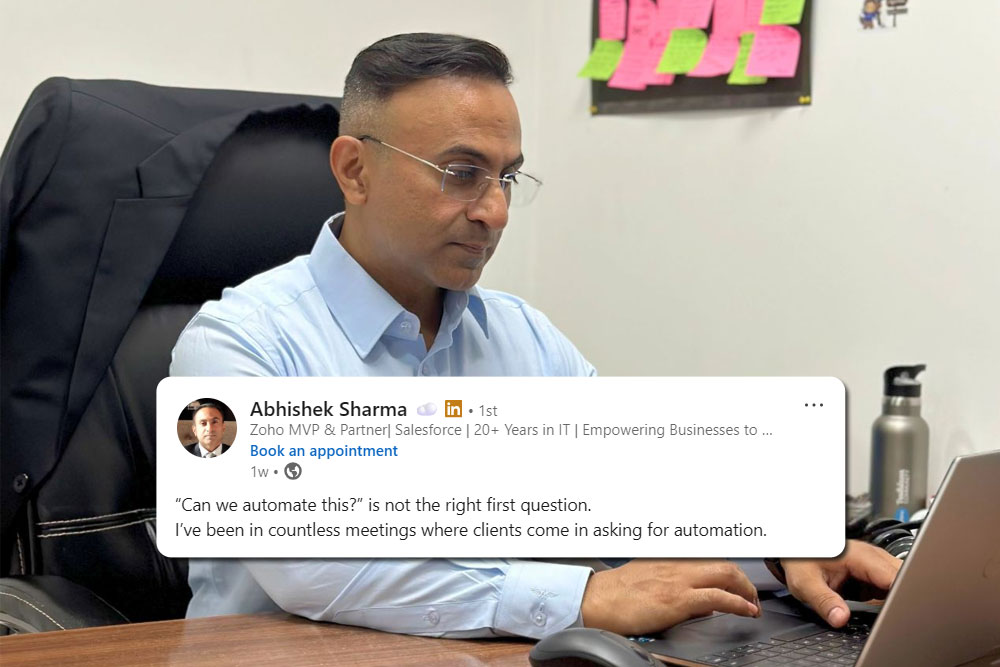
In a LinkedIn post, Abhishek shared a hard truth many of us in the Zoho ecosystem know but don’t say enough:
“‘Can we automate this?’ is not the right first question.”
Let’s unpack this powerful insight and explore how you can apply it to your Zoho projects for better outcomes.
The Automation Trap
Many clients approach consultants and developers with one thing in mind: automation.
They’ve heard that Zoho CRM or Creator can “do everything.”
They want workflows, blueprints, custom functions, and scheduled scripts.
But when we stop and ask the critical question:
“Why do you want to automate this?”
— that’s when things start to unravel.
As Abhishek puts it:
“Sometimes it’s a workaround for a broken process. Sometimes it’s to reduce work they shouldn’t be doing in the first place. And sometimes, they’re trying to force-fit automation into a process that doesn’t even need to exist.”
The Right Questions to Ask Before Automating
Before jumping into writing Deluge scripts or creating complex workflows, there are three key questions every business should ask:
Is the process clearly defined?
If your current workflow is vague or inconsistent, automating it will only amplify the confusion.
Is it necessary at all?
Some processes were born out of old limitations or internal habits. Are they still relevant?
Can it be simplified first?
There’s no point in automating a 10-step process if you can first reduce it to 3 steps.
In one of Abhishek’s projects, simply asking these questions helped the team eliminate 5 redundant steps before a single line of Deluge was written. That’s the power of clarity.
Automation is a Magnifier, Not a Fixer
There’s a common misconception that automation solves problems. In truth, it magnifies what’s already there. If your process is inefficient, automating it won’t fix it — it will just make it fail faster.
“Automation isn’t a magic wand. It’s a magnifier.” — Abhishek Sharma
It’s like pouring fuel on a car. If the engine is broken, the car still won’t go far — even with a full tank.
Clarity First, Automation Second
The real ROI of automation comes after process clarity. Only when you know what the process should do, who owns each step, and why it exists, should you start building automation around it.
Here’s a simple framework you can follow before you automate in Zoho:
- Document the current process in plain language or a flowchart.
- Challenge each step: Why is it there? Is it needed?
- Simplify wherever possible.
- Then automate, keeping logic clear and easy to maintain.
Sometimes the Best Automation is No Automation
In some cases, once the process is reviewed and optimized, the team realizes they don’t need automation at all. A manual step might take only 10 seconds and isn’t worth building or maintaining an automation rule.
This is especially true when:
- The process is infrequent
- The data is inconsistent
- The stakeholders keep changing the flow
- The ROI of building automation is lower than expected
Thanks to Abhishek Sharma for sparking this important conversation. His experience as a Zoho MVP and consultant brings a grounded, real-world perspective that’s often missing in automation discussions.
“If you’re considering automating something in Zoho, pause and map the logic first. Sometimes the best automation is no automation at all.”
As consultants, developers, and business owners — this is a mindset we must embrace.
Over to You
What’s a process you once thought needed automation, but later realized didn’t?
Let’s hear your stories — comment below!
About Abhishek Sharma
Abhishek Sharma is a Zoho MVP and Partner, known for his practical, process-first approach to CRM and business automation. Follow his work on LinkedIn for more insights.

















Leave a comment