


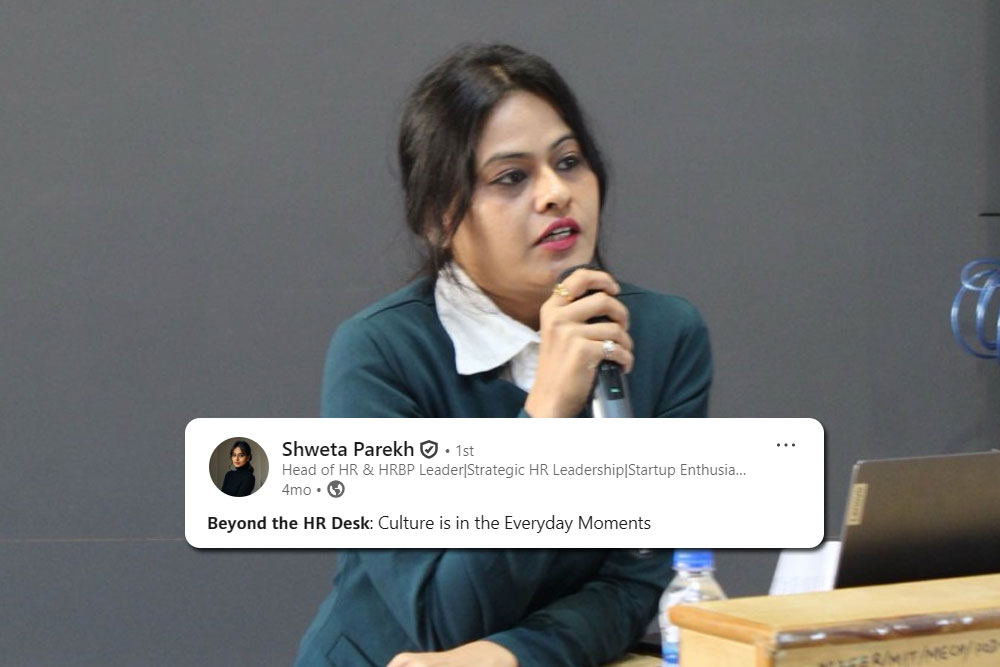
In a recent LinkedIn post that deeply resonated with professionals across industries, Shweta Parekh—a seasoned HR leader and one of Asia’s Top 30 HR Leaders—beautifully captured what many often overlook: workplace culture isn’t confined to boardrooms or policy documents—it lives in the small, everyday moments.
Her words reflect a profound truth that’s often forgotten in the rush of corporate strategies and KPIs. “Culture is shaped in the moments that happen between meetings, deadlines, and everyday interactions,” she wrote. And if you pause and think about it, that’s exactly where the soul of an organization resides.
The Unscripted Spaces Where Culture Lives
We often imagine culture as something decided by top leadership or laid out in HR manuals. But Shweta rightly points out that some of the most impactful elements of a workplace culture are born in informal settings—those unscripted, human moments that make work feel more like a community than a contract.
- A quick sync meeting that turns into a heartfelt brainstorming session.
- The coffee machine where spontaneous huddles spark creative ideas.
- The light banter in a shared workspace that turns into a problem-solving breakthrough.
- The quiet empathy when a colleague waits patiently during a laggy screen share.
These are not isolated incidents. These are the building blocks of a culture where people feel seen, heard, valued, and empowered.
The Role of Leadership in Cultivating These Moments
As Head of HR (Flentas), Shweta Parekh is no stranger to strategy. But what sets her apart is her emphasis on the human side of HR. As a Startup Enthusiast, Employer Branding Champion, and Talent Management Expert, she has consistently advocated for cultures where people are not just employees—they are contributors, collaborators, and culture-shapers.
Great leaders don’t just focus on what happens in the boardroom. They empower and recognize the interactions that happen beyond it. They build systems that celebrate collaboration over hierarchy, communication over control, and trust over micromanagement.
From Policy to Practice: Where Culture Really Takes Root
Company values and mission statements are important, but if they don’t translate into everyday behavior, they’re just words on paper. Shweta’s post reminds us that true culture is what people do when no one is watching. It’s lived in how:
- Managers give space for experimentation without fear of failure.
- Teammates acknowledge each other’s small wins.
- Colleagues show up for each other on a bad day—or celebrate a personal milestone like it’s their own.
This lived culture has a ripple effect—it boosts morale, increases retention, strengthens employer branding, and ultimately drives results.
Culture Is Everyone’s Responsibility
While HR plays a crucial role in guiding and enabling a healthy culture, the responsibility doesn’t stop there. Every team member contributes to it—actively or passively. Whether you’re a junior associate or a department head, your actions add to the collective vibe.
As Shweta’s post gently nudges us to realize: “Great culture isn’t just written in policies—it’s lived in the way we connect, communicate, and grow together.”
Final Thoughts
In a world increasingly focused on automation, metrics, and rapid scaling, leaders like Shweta Parekh remind us that culture is human at its core. Her post isn’t just a reflection—it’s a call to action for organizations to pay attention to the small things, because that’s where the magic really happens.
So the next time you’re chatting over coffee or waiting on a screen share, remember: you’re not just passing time—you’re participating in the living, breathing culture of your company.
About Shweta Parekh
Shweta Parekh is a dynamic Head of HR (Flentas) with a proven track record in strategic HR leadership, employee engagement, talent acquisition, and employer branding. She has been recognized as one of Asia’s Top 30 HR Leaders. Her voice in the HR community is not only influential but also deeply rooted in empathy, authenticity, and innovation.













Leave a comment