


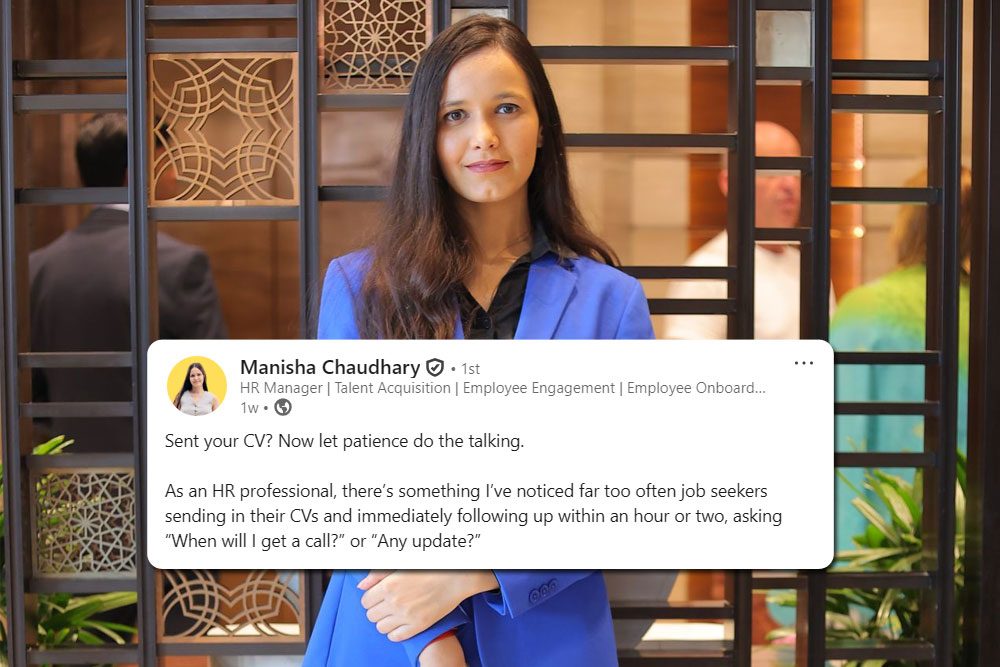
Sent Your CV? Now Let Patience Do the Talking.
The anxiety of job hunting is real.
You spend hours polishing your CV, tailoring your cover letter, and researching the company. You finally hit Submit — and then the waiting begins. Within a few hours, that inner voice kicks in:
“Should I follow up? What if they missed my application? Maybe I should message the HR…”
It’s a natural urge. But according to HR professional Manisha Chaudhary, that quick follow-up can do more harm than good.
In her widely appreciated LinkedIn post, she calls out a common — and easily avoidable — mistake:
“I’ve noticed job seekers sending in their CVs and immediately following up within an hour or two, asking ‘When will I get a call?’ or ‘Any update?’”
Let’s break down why this is problematic, what happens on the recruiter’s side, and how candidates can respond more professionally.
What Actually Happens After You Submit Your CV?
It’s important to understand the process from the recruiter’s side. Once your CV enters the system, it doesn’t go straight to a hiring manager’s desk. In most cases, it follows a series of steps:
- Initial Screening: The HR team or software filters candidates based on basic qualifications.
- Shortlisting: Recruiters manually review shortlisted resumes for fit.
- Team Coordination: Discussions take place with the hiring department to schedule interviews.
- Role Prioritization: Not all open positions are urgent. Some may be on hold temporarily.
- Volume Handling: Many companies receive hundreds of applications — and reviewing each takes time.
Recruiters are not ignoring you — they’re just working through a queue that you’re now a part of.
Following Up Too Soon Sends the Wrong Signal
While following up in itself isn’t wrong, the timing and tone matter.
Sending a message just hours after applying doesn’t show initiative — it often shows impatience or a lack of understanding of professional timelines.
Imagine this from the recruiter’s perspective:
- They receive your CV at 10:00 AM.
- At 12:00 PM, you message: “Hi, any update?”
- At 2:00 PM, you call the company reception for a status check.
This creates pressure, not interest. It comes across as if you’re not confident enough in your own application to let it speak for itself.
Patience is Not Passive — It’s Professional
There’s a misconception that waiting is passive. But being patient after submitting your CV is actually a form of emotional intelligence.
Patience shows:
- Maturity
- Respect for process
- Confidence in your application
- Understanding of professional boundaries
Manisha perfectly sums it up:
“Patience is not weakness. It’s a sign of professionalism.”
And in today’s competitive world, professionalism is what sets strong candidates apart from average ones.
So, When Should You Follow Up?
Follow-ups are important — but they need to be timely and respectful. Here’s a simple rule of thumb:
- Wait at least 5–7 working days after applying.
- If the job posting has a closing date, follow up a few days after that.
- When following up, keep it short, polite, and non-intrusive.
Example message:
Hi [Recruiter Name], I hope you’re doing well. I applied for the [Job Title] position on [Date], and I just wanted to check in to see if there’s any update on the hiring process. I remain very interested in the opportunity and appreciate your time and consideration.
That’s it. No long pitch. No demand. Just a polite check-in.
What to Do While You Wait
The best way to deal with the uncertainty of job applications is to keep moving. Here’s what you can focus on instead of refreshing your inbox:
Apply to More Jobs
Don’t pin all your hopes on one role. The more you apply (smartly, not blindly), the higher your chances.
Upgrade Your Skills
Take a short course, attend a webinar, or start building a portfolio project that strengthens your profile.
Polish Your Personal Brand
Update your LinkedIn. Write a thoughtful post. Engage with industry content. Hiring managers often check your profile.
Customize the Next Application
Use what you learned from the last job description to improve the next application. Each effort should be better than the last.
Practice Interviewing
If you get that call, you want to be ready. Start preparing now — especially for roles you care most about.
Think Long-Term: Your Reputation Matters
Recruiters remember more than you think. If you come across as respectful, thoughtful, and professional — even when not selected — you leave a positive impression.
That can lead to:
- Future role consideration
- Referrals to other departments
- Networking opportunities
On the other hand, being pushy, impatient, or demanding can burn bridges — even with companies you admire.
Final Thoughts: Let Your CV Speak First
To wrap it up — job hunting is not easy. The wait can be stressful. But professionalism is tested in these very moments.
Here’s a quick recap:
- Don’t message the recruiter within hours of applying.
- Respect the time and process involved in hiring.
- Follow up politely after a reasonable period.
- Keep improving yourself in the meantime.
- Trust that if it’s meant for you, it will happen.
Let your CV speak for you first. Then let time, patience, and preparation do the rest.
As Manisha Chaudhary beautifully said:
“Good things take time. So should the hiring process.”
About the Author of the Insight
This blog was inspired by a thoughtful LinkedIn post by Manisha Chaudhary, an HR professional who regularly shares real-world advice for job seekers and professionals.
You can follow her for more such insights here: Manisha’s LinkedIn Profile














Leave a comment